

Energy Storage Drawer Cabinet Assembly Line – Modular Intelligence & Precision Assembly Craft
1. Overall Line Architecture
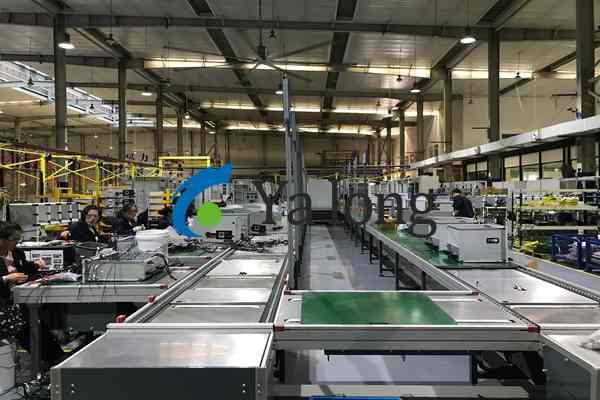
This assembly line adopts a bilaterally symmetric modular design concept, with a central logistics aisle as the axis and independent assembly operation zones on both the left and right sides. As visible in the image, the line is constructed from aluminum alloy profile frameworks with anodized surfaces, offering both lightweight properties and high structural strength. Workstation surfaces are equipped with green anti-static mats to meet ESD (Electrostatic Discharge) protection requirements for the electronic components inside the storage cabinets. The entire line runs through a spacious standardized factory building, with a steel grid ceiling structure and LED linear lighting system providing stable illumination for precision assembly operations.
2. Core Process Stages
2.1 Drawer Cabinet Body Pre-processing Station
The front end of the line features a cabinet skeleton pre-assembly zone. Aluminum alloy or cold-rolled steel sheets, after laser cutting and CNC bending, are assembled here into frame structures. Operators use locating pins and quick-clamping fixtures to pre-fix foundational components including side panels, base plates, and rail support brackets. This station emphasizes dimensional datum unification, ensuring that subsequent drawer units can slide in with precise alignment.
2.2 Drawer Unit Assembly Station
This represents the core process segment of the entire line. Energy storage drawer cabinet units typically comprise battery module brackets, BMS (Battery Management System) mounting plates, high-voltage connector bases, and cooling air duct sub-components. Operators follow work instructions to sequentially complete:
- Mechanical Assembly: Guide rail installation, limit block positioning, locking mechanism adjustment
- Electrical Assembly: Copper busbar connection, signal harness routing, connector pre-insertion
- Thermal Management Assembly: Thermal pad application, air duct partition installation
Stations are interconnected via a double-speed chain conveyor system, where pallet carriers are smoothly driven by the chain. Takt time can be flexibly adjusted in the PLC system according to order requirements.
2.3 Integration Testing Station
After initial assembly, drawer units enter the in-line inspection phase. This station is equipped with dedicated test interfaces to perform insulation withstand voltage testing, circuit continuity verification, and BMS communication function validation. Test data is uploaded to the MES system in real-time, enabling digital quality traceability.
2.4 Final Assembly & Aging Station
Drawer units that pass testing are conveyed to the final assembly zone for integration with the main cabinet body. This stage focuses on completing main circuit busbar connections, grounding system construction, and cabinet door seal gasket compression. Some line terminals also feature load aging test positions that simulate actual operating conditions to expose potential defects in advance.
3. Conveyor & Logistics System
The conveyor track clearly visible in the image employs a dual-layer double-speed chain structure: the upper layer carries assembly pallets while the lower layer handles empty pallet return. This closed-loop design reduces manual handling and improves space utilization. Pallet surfaces are covered with green anti-slip mats, with locating blocks at the edges to prevent drawer unit displacement during transfer.
For material supply, multi-tier material racks and lean pipe racks are configured on both sides of the line, with commonly used standard parts (screws, terminals, rails) stored near their respective workstations. Large components (such as battery modules) are delivered via AGVs or forklifts through the central aisle on a scheduled basis, implementing pull-based replenishment.
4. Process Features & Quality Control
4.1 Flexible Design
This assembly line supports mixed-model production of multiple drawer cabinet types. By replacing locating modules on pallets and adjusting workstation operation programs, product changeover can be completed within a relatively short timeframe, adapting to the small-batch, high-variety order characteristics of the energy storage market.
4.2 Error-proofing Mechanisms
Critical stations are equipped with photoelectric sensors and torque-monitored electric screwdrivers, providing real-time alarms for abnormalities such as missing parts, incorrect installation, or insufficient tightening torque. For some high-risk operations, torque-controlled air drivers combined with barcode scanning provide dual confirmation to ensure assembly quality consistency.
4.3 Ergonomic Optimization
Workstation surface heights, tool hanging positions, and lighting angles are all designed according to ergonomic standards, reducing operator fatigue. Drawer unit weights are carefully calculated, with assistive manipulator interfaces reserved at stations exceeding 15kg, balancing efficiency with occupational health considerations.
5. Application Scenarios
This assembly line primarily serves the following product domains:
- Commercial & Industrial Energy Storage Systems: Outdoor cabinets, containerized energy storage drawer-type battery compartments
- Data Center UPS Energy Storage: High-density, hot-swappable backup power drawer cabinets
- Rail Transit Energy Storage: Special drawer cabinets with seismic resistance and fire protection requirements
6. Conclusion
An energy storage drawer cabinet assembly line is far more than a simple arrangement of equipment — it is a systematic engineering solution integrating precision mechanical assembly, electrical safety craftsmanship, and digital quality management. As seen in the image, the clean and orderly workstation layout, standardized conveyor system, and focused operators together form a modern manufacturing production line for energy storage equipment. Against the backdrop of rapid development in the new energy industry, such assembly lines — through continuous optimization of line balancing and the introduction of automated inspection methods — are providing a solid manufacturing foundation for the large-scale, high-quality delivery of energy storage products.
If you have any questions or needs about the automated assembly line, please contact us via email: yu.yalong@outlook.com