EXECUTIVE OVERVIEW
PRODUCT CATEGORY: Medium-to-High Voltage Electrical Distribution Equipment
PRODUCTION SCALE: Heavy Industrial / High-Volume Project Manufacturing
CORE DESIGN PRINCIPLE: Life-Safety Critical Assembly with Grid-Grade Reliability
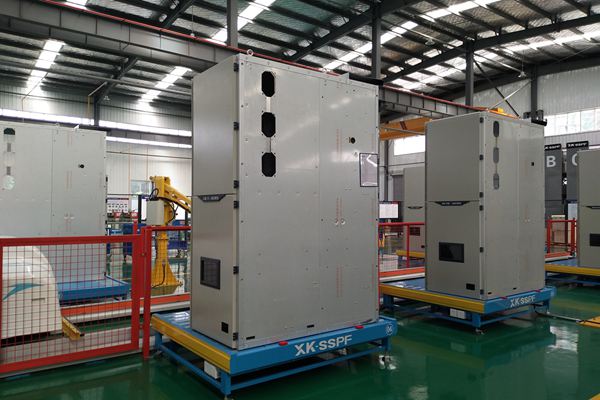
The facility presented here is a dedicated switchgear manufacturing ecosystem—a heavy industrial environment where electrical distribution equipment is assembled under rigorously controlled conditions. Unlike consumer electronics or automotive assembly, every unit produced in this facility carries a profound responsibility: to protect human life and grid infrastructure from electrical faults generating destructive forces exceeding thousands of amperes.
The visible metal-clad enclosures, overhead bridge cranes, and mobile assembly platforms reveal a production system engineered for objects that may weigh several tons yet must operate with micron-level precision in their dielectric clearances and contact alignments.
FACILITY SPECIFICATIONS
| ATTRIBUTE | DETAIL |
|---|---|
| Structural System | Heavy-gauge steel platforms with reinforced load-bearing capacity |
| Material Handling | Overhead bridge cranes + mobile platform bases |
| Floor System | Reinforced concrete (high-bay configuration) |
| Roof Structure | High-bay steel roofing with integrated crane runways |
| Product Weight Range | Several tons per assembled cubicle |
| Voltage Classes | Medium voltage to high voltage (project-specific) |
| Applicable Standards | IEC 62271 / ANSI C37 series |
ASSEMBLY SEQUENCE
The build process follows a five-phase progression, where each phase must be completed and verified before the unit advances:
PHASE 1 — ENCLOSURE & COMPARTMENTALIZATION
Structural frame assembly → compartmentalized section fabrication → arc flash containment barrier installation → cable termination area preparation
PHASE 2 — BUSBAR SYSTEM INTEGRATION
Precision cutting and bending of copper/aluminum conductor bars → insulation application → phase spacing verification → creepage distance validation → torque-critical connection execution
PHASE 3 — CIRCUIT BREAKER INSTALLATION
Vacuum or SF6 interruption unit mounting → operating mechanism assembly → interlocking system installation → mechanical linkage alignment → functional sequence verification
PHASE 4 — CONTROL & PROTECTION SYSTEM
Current/voltage transformer installation → protective relay module wiring → metering instrumentation → terminal block circuit identification → control logic verification
PHASE 5 — ENCLOSURE CLOSING & FINAL TESTING
Door and panel installation → nameplate marking → comprehensive electrical testing → protective wrapping for shipment
SAFETY & QUALITY REGIMEN
IN-PROCESS CONTROLS
- Dimensional verification at every workstation
- Busbar alignment and contact pressure validation
- Insulation clearance measurement against design specifications
- Torque documentation for all critical electrical connections
- Contamination control protocols for dielectric systems
FINAL ELECTRICAL TESTING
- Insulation resistance measurement
- Contact resistance testing
- Power frequency withstand voltage (hipot) testing
- Partial discharge detection
- Temperature rise validation under rated current
- Circuit breaker operating time verification
- Interlock functionality testing
- Protective relay coordination confirmation
CERTIFICATION OUTPUT
- Type test certificates (generated in parallel with production)
- Routine test documentation
- Component traceability records (serial numbers, batch codes, material certifications)
- Regulatory compliance dossiers for target markets
WORKSTATION ARCHITECTURE
MOBILE PLATFORM SYSTEM
Each switchgear unit rests on a mobile platform base—the defining mechanical feature of this line. These platforms provide:
- Stable, vibration-free positioning during precision assembly
- Controlled progressive movement between stations
- Buffer accumulation capability between operations of varying cycle times
OVERHEAD MATERIAL HANDLING
Bridge cranes integrated throughout the facility enable:
- Safe manipulation of several-ton cubicle assemblies
- Precise placement of heavy circuit breaker modules
- Elimination of manual lifting for all large-format components
CONTROLLED ACCESS ZONES
- Safety barriers separating active assembly from pedestrian walkways
- Designated material staging areas within ergonomic reach
- Wide crane operating zones with unobstructed vertical clearance
- Task lighting and ventilation optimized for busbar and insulation work
PRODUCTION FLEXIBILITY
MIXED-MODEL CAPABILITY
The line accommodates concurrent assembly of:
- Multiple voltage classes (medium to high voltage)
- Various current ratings and short-circuit withstand levels
- Different breaker technologies (air / vacuum / SF6)
- Custom compartmentalization schemes
- Project-specific control and communication requirements
OPERATIONAL SCALABILITY
- Staffing levels and shift patterns adjustable to project schedules
- Workstation tasks rebalanced via takt time analysis
- Modular platform design allows reconfiguration for design changes
- Standardized tooling and pre-staged kits minimize changeover time
MATERIAL LOGISTICS
SEQUENCED DELIVERY
- Components delivered via overhead crane or forklift directly to point-of-use
- Bill of Materials synchronized to each station’s consumption rate
- Heavy electrical components (CTs, VTs, breakers) handled mechanically—zero manual lifting
INVENTORY CONTROL
- Work-in-progress levels managed to minimize floor space while buffering supplier lead time variability
- Wide perimeter aisles designed for crane and forklift operation
- Component traceability maintained from receipt through final assembly
CONCLUSION
This switchgear assembly line is a purpose-engineered production system at the intersection of heavy industrial manufacturing and critical electrical safety. The floor-based progressive configuration, mobile platforms, and overhead crane infrastructure provide the structural certainty required for assembling equipment that may determine the difference between contained electrical faults and catastrophic grid failures.
As global electrical infrastructure undergoes modernization—integrating renewable energy sources, accommodating bidirectional power flows, and implementing smart grid communications—assembly lines such as this one serve as the foundational manufacturing backbone of the power sector. They are adaptable to evolving voltage levels, responsive to project-specific engineering requirements, and uncompromising in their commitment to the safety protocols that protect both personnel and the public.
Every switchgear unit leaving this facility carries not merely electrical current, but the sovereign responsibility of grid reliability—a mandate fulfilled through the synthesis of skilled electrical technician expertise, systematic process control, and heavy-duty manufacturing precision.