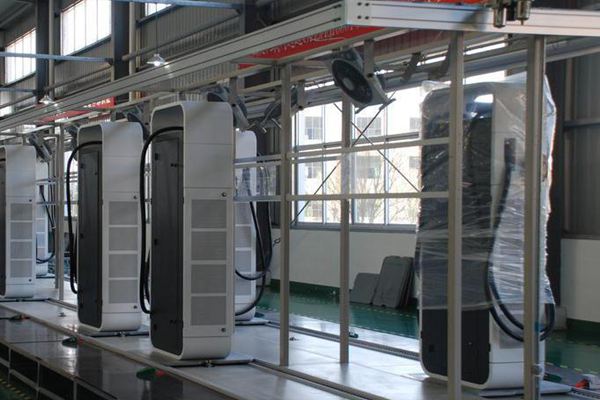
EV Charging Pile Assembly Line
A Comprehensive Overview of Production Engineering
The Production Environment
The image presents a dedicated EV charging pile assembly line—a specialized manufacturing ecosystem engineered for the systematic construction of electric vehicle charging infrastructure. This facility represents the convergence of heavy-duty industrial engineering and high-voltage electrical safety protocols, where the physical demands of large-format equipment meet the precision requirements of clean energy technology.
Unlike consumer electronics or automotive assembly, this production environment must accommodate units exceeding 100 kilograms and handling electrical currents up to several hundred amperes. The visible charging pile housings, cable management systems, and protective wrapping indicate a complete integration process: transforming individual subassemblies into fully functional AC and DC charging stations ready for commercial and public deployment.
I. Structural Foundation: Built for Scale
The assembly line is built upon a floor-mounted conveyor configuration, specifically engineered to manage the substantial physical dimensions and weight of charging pile units.
Heavy-Gauge Framework
The structural backbone employs heavy-gauge steel and aluminum extrusion profiles with robust mounting capabilities. This is not merely a conveyor—it is a load-bearing infrastructure designed to support large-format charging units throughout the entire assembly sequence. The low-profile conveyor mechanism ensures stable, progressive movement while maintaining ergonomic access for operators working on tall, freestanding housings.
Overhead Utility Architecture
A gantry system spans the full length of the line, delivering electrical power, compressed air, and data connectivity to each workstation without encroaching on floor-level material flow. This overhead distribution model is essential: charging pile assembly requires substantial floor space for component staging and heavy material handling equipment, leaving no room for ground-level utility obstructions.
Industrial-Grade Environment
The facility’s high-bay windows and reinforced flooring reflect the demanding physical requirements of charging infrastructure manufacturing. This is an industrial-grade environment where outdoor durability standards, safety certification requirements, and high-voltage handling protocols dictate every design decision.
II. Workstation Design: Vertical Ergonomics
Charging pile assembly presents a unique ergonomic challenge—the product is vertically oriented and substantially larger than typical consumer electronics or even automotive components.
Multi-Level Access Strategy
Workstations are engineered with vertical support columns and open-frame designs that provide structural stability while granting operators unobstructed access to all sides of the charging unit. This is critical because a single charging pile requires assembly work at both lower housing sections (cable entry, ventilation) and upper control interfaces (touch screens, RFID readers, payment systems).
Thermal and Visibility Management
Overhead lighting and ventilation systems are specifically configured for the thermal demands of power module installation and high-voltage testing. These are not standard assembly conditions—power electronics generate significant heat during testing, and visibility must be maintained at all working heights to ensure precision and safety.
Scaled Material Presentation
Component staging areas are proportionally designed for the larger physical scale of charging infrastructure. The spacing between workstations incorporates additional clearance to accommodate the substantial footprint of each unit, while tool holders and testing fixtures are positioned within the operator’s reach envelope to minimize unnecessary movement.
III. Assembly Process: The High-Voltage Build
The transformation from individual components to a fully functional charging station follows a structured, safety-critical sequence:
Phase 1 — Structural Housing Assembly
Base chassis preparation, weatherproof enclosure installation, cable entry glands, and ventilation system mounting. These foundational elements must meet IP rating standards for outdoor exposure, making sealing integrity a primary concern from the very first operation.
Phase 2 — Power Module Integration
At dedicated stations, AC-DC conversion units, rectifier modules, and power distribution systems are installed within the housing. These high-current components require precise alignment and secure fastening—there is no margin for error when dealing with electrical currents of this magnitude.
Phase 3 — Control System Assembly
Touch screen interfaces, RFID readers, payment system modules, and network communication units are integrated. This phase bridges the mechanical and digital domains, requiring both electrical expertise and software configuration knowledge.
Phase 4 — Cable Management & Connector Integration
High-current cables are routed through the housing with strain relief mechanisms installed at connection points. Connector heads are attached and tested for mechanical durability. The physical routing of these cables is critical—improper strain relief can lead to connector failure under repeated use.
Phase 5 — System Integration & Protective Packaging
Final electrical connections are completed, firmware is loaded, and units are prepared for shipment with protective wrapping designed for transit safety.
Safety Protocols
Given the high-voltage nature of the product, every stage incorporates lockout-tagout procedures and insulated tool requirements. Operator safety is not a checklist item—it is woven into the fabric of every assembly operation.
IV. Quality Assurance: Electrical Safety as Foundation
Quality control in EV charging pile manufacturing is fundamentally different from other assembly lines. The consequences of failure are not merely functional—they are safety-critical.
In-Process Verification
Every workstation incorporates visual inspection and functional verification tailored to the specific assembly operation. Torque specifications for high-current connections, connector engagement depth, and grounding integrity are verified before the unit advances.
Comprehensive Electrical Testing
The final sections of the line feature rigorous validation protocols:
- Insulation Resistance Testing: Validates dielectric strength between live components and ground.
- Ground Continuity Verification: Ensures safety grounding meets regulatory requirements.
- High-Potential (Hipot) Testing: Subjects the entire electrical system to elevated voltage to confirm insulation integrity.
- Functional Load Testing: Verifies power output accuracy under simulated operating conditions.
- Communication Protocol Compliance: Validates OCPP and other network communication standards for connected units.
Environmental Validation
Thermal imaging during load testing identifies potential hot spots in power electronics before units leave the factory. Environmental sealing tests verify IP rating compliance for outdoor installations, simulating rain, dust, and temperature extremes.
Certification Documentation
Regulatory approvals are generated in parallel with testing, creating a comprehensive certification package for each unit. This documentation supports market access in regions with varying safety standards and regulatory frameworks.
V. Material Flow: Heavy-Scale Logistics
The assembly line operates within a structured supply system designed for the substantial physical dimensions of charging pile components.
Heavy Component Handling
Power modules, housing sections, and other heavy subassemblies are delivered via forklifts or overhead cranes directly to station sides, minimizing manual handling. This is not a line where operators can lift components by hand—the scale demands mechanical assistance at every stage.
Just-in-Time Synchronization
Components are supplied in kit form or through sequenced delivery systems aligned with each station’s Bill of Materials. The linear configuration supports efficient material delivery along the line perimeter, with wide aisles specifically designed to accommodate material handling equipment and the substantial footprint of charging pile units.
Traceability Systems
Component serial numbers and batch codes are tracked throughout the assembly process, creating a digital thread that enables precise quality回溯 and warranty support. This traceability is particularly critical for safety-certified electrical infrastructure, where regulatory audits may require component-level documentation years after installation.
VI. Production Capacity: Adapting to a Shifting Market
The EV charging infrastructure industry is in a state of rapid evolution. The assembly line is engineered for maximum adaptability in response to this volatility.
Mixed-Model Production
The line supports concurrent assembly of dramatically different configurations:
- AC residential units (7kW) for home charging
- DC fast charging stations (350kW+) for highway corridors
- Connector type variations (CCS, CHAdeMO, GB/T) for regional compatibility
- Communication feature sets for networked vs. standalone operation
Modular Rebalancing
The workstation design allows for rapid reconfiguration when product designs evolve or when optimizing for demand fluctuations. Multiple operators can be assigned to high-complexity stations (power module installation, system testing), while simpler operations can be combined to streamline flow.
Changeover Efficiency
Transitions between product variants are streamlined through standardized tooling and documented setup protocols. This agility is essential in an industry where charging standards, regional regulations, and customer specifications are still actively evolving.
Conclusion
This EV charging pile assembly line represents a purpose-built manufacturing system at the intersection of heavy industrial engineering and clean energy technology. The floor-mounted conveyor configuration provides the structural foundation for consistent assembly of large-format electrical equipment, while comprehensive electrical safety testing ensures that every unit meets the rigorous standards required for public deployment.
As electric vehicle adoption accelerates globally, assembly lines such as this one serve as critical infrastructure in the energy transition. They are adaptable to evolving charging technologies, scalable to meet surging demand, and uncompromising in their commitment to safety and reliability.
The combination of skilled operator expertise, systematic process control, and high-voltage safety rigor exemplifies the modern approach to infrastructure manufacturing. Each unit that leaves this line carries not just electrical current, but the responsibility of public safety and the promise of a sustainable transportation future.