In transformer manufacturing, insulation media and cooling methods directly dictate fundamental variations in production line configurations and logistics architectures. Focusing on the two mainstream product routes—oil-immersed and epoxy resin cast dry-type transformers—their respective automated systems exhibit distinctly different technical characteristics in process focus, material handling equipment, and workshop layout. Based on actual production scenarios, this article deconstructs the core components of these two types of transformer assembly lines.
I. Oil-Immersed Transformer Production Line: An Assembly & Testing System Centered on Roller Conveyors
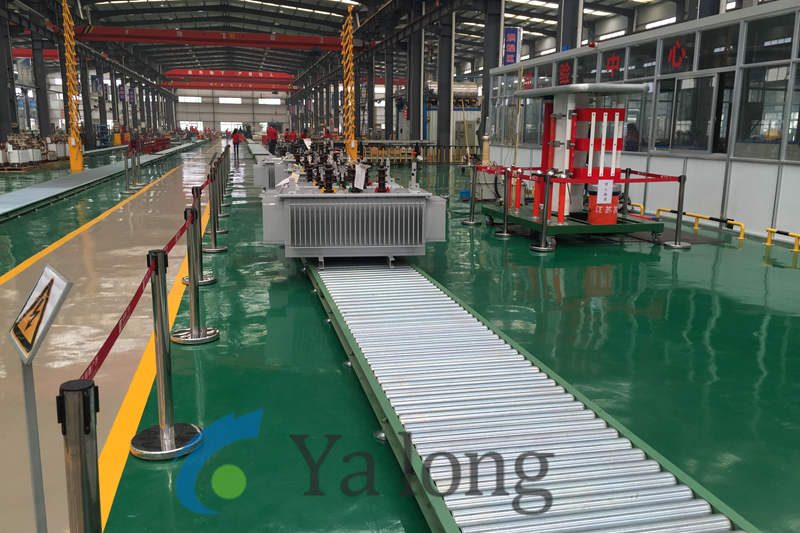
From a holistic view, the oil-immersed transformer assembly line displays distinct heavy-duty assembly characteristics. Its most immediate visual identifiers are roller conveyor lines laid across the floor from end to end, and overhead bridge cranes used for heavy lifting.
Core Logistics Architecture: Roller Conveyor Lines
Due to the large size and weight of oil-immersed units, coupled with frequent electrical testing requirements, ground-level logistics rely heavily on powered or unpowered roller conveyors. These lines feature high load-bearing capacity and stable operation, enabling continuous flow of assembled bodies between final assembly stations, vacuum oil-filling equipment, and testing areas. Compared to complex rail-guided vehicle systems, roller conveyors are better suited for linear, high-tonnage product displacement within this type of production environment.
Process Focus: Vacuum Oil Filling & Sealing Tests
Core process nodes revolve around “core drying – vacuum oil filling – sealing tests.” After coils are assembled onto the core, they undergo vacuum drying to remove moisture, followed by insulating oil injection under vacuum. Oil-filled products are then conveyed directly via roller lines to high-voltage testing stations for turns ratio, withstand voltage, and partial discharge verification.
Application Scenarios
This configuration primarily serves power distribution needs for outdoor substations, grid infrastructure, and large industrial enterprises. Line design emphasizes takt time matching for heavy-duty logistics and automated integration of testing processes.
II. Dry-Type Transformer Automated Production Line: A Casting & Curing System with RGV & KBK Synergy
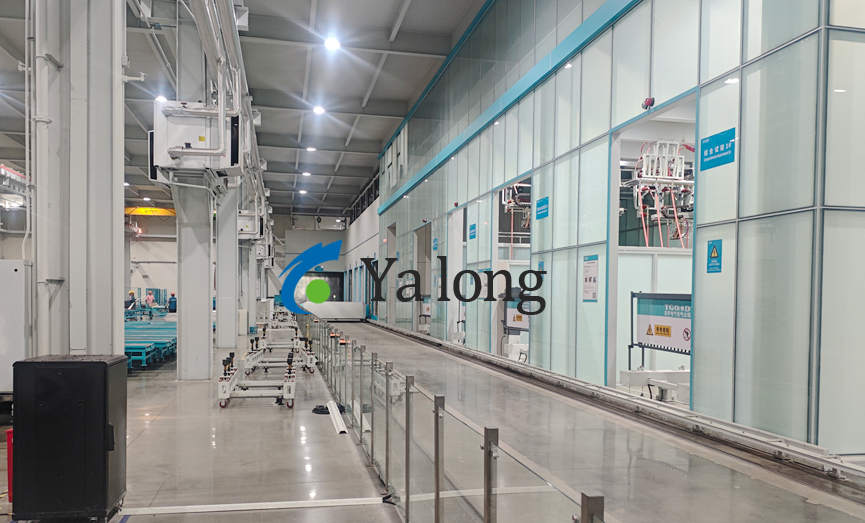
Unlike the heavy-duty style above, the dry-type transformer assembly line (especially resin-cast variants) exhibits highly integrated precision manufacturing characteristics. Its core processes—epoxy resin vacuum casting and high-temperature curing—dictate an enclosed, high-precision logistics model.
Core Logistics Architecture: RGV & KBK Combination
Floor-embedded RGVs handle core material delivery, precisely transporting dedicated tooling racks loaded with coil molds to vacuum casting tanks and curing ovens according to takt time. Simultaneously, overhead KBK flexible suspension cranes manage mold lifting and clamping. This three-dimensional “ground RGV + overhead KBK” logistics model enables damage-free transfer of heavy molds between enclosed workstations.
Process Focus: Vacuum Casting & Stepped Curing
The technical core lies in vacuum pressure casting of epoxy resin. Wound coils are evacuated inside molds, injected with degassed resin mixture, and transferred to curing oven clusters. Ovens execute multi-segment temperature curves via PLC to ensure full cross-linking. Through cyclic RGV delivery, mold loading, casting, curing, and demolding are linked into a continuous takt cycle.
Application Scenarios
Such systems primarily target indoor power distribution scenarios with strict fire/explosion-proof requirements—high-rise buildings, rail transit, and data centers. Design prioritizes process parameter stability, batch consistency, and clean environment control.
III. Core Differences Between the Two Types of Transformer Assembly Lines
IV. Non-Standard Customization & Selection Recommendations
A transformer assembly line is inherently non-standard custom equipment. Enterprises must first clarify product positioning:
- For high-capacity outdoor oil-immersed transformer assembly lines, roller conveyor layout and load-bearing design are critical success factors.
- For high-value-added indoor dry-type transformer assembly lines, integration level of RGV logistics and vacuum casting equipment determines quality ceilings.
Regardless of type, modular configuration must align with facility column grids, crane interfaces, and capacity targets. Rational non-standard design enables full-process automation—from raw material loading to finished goods warehousing—for any modern transformer assembly line.